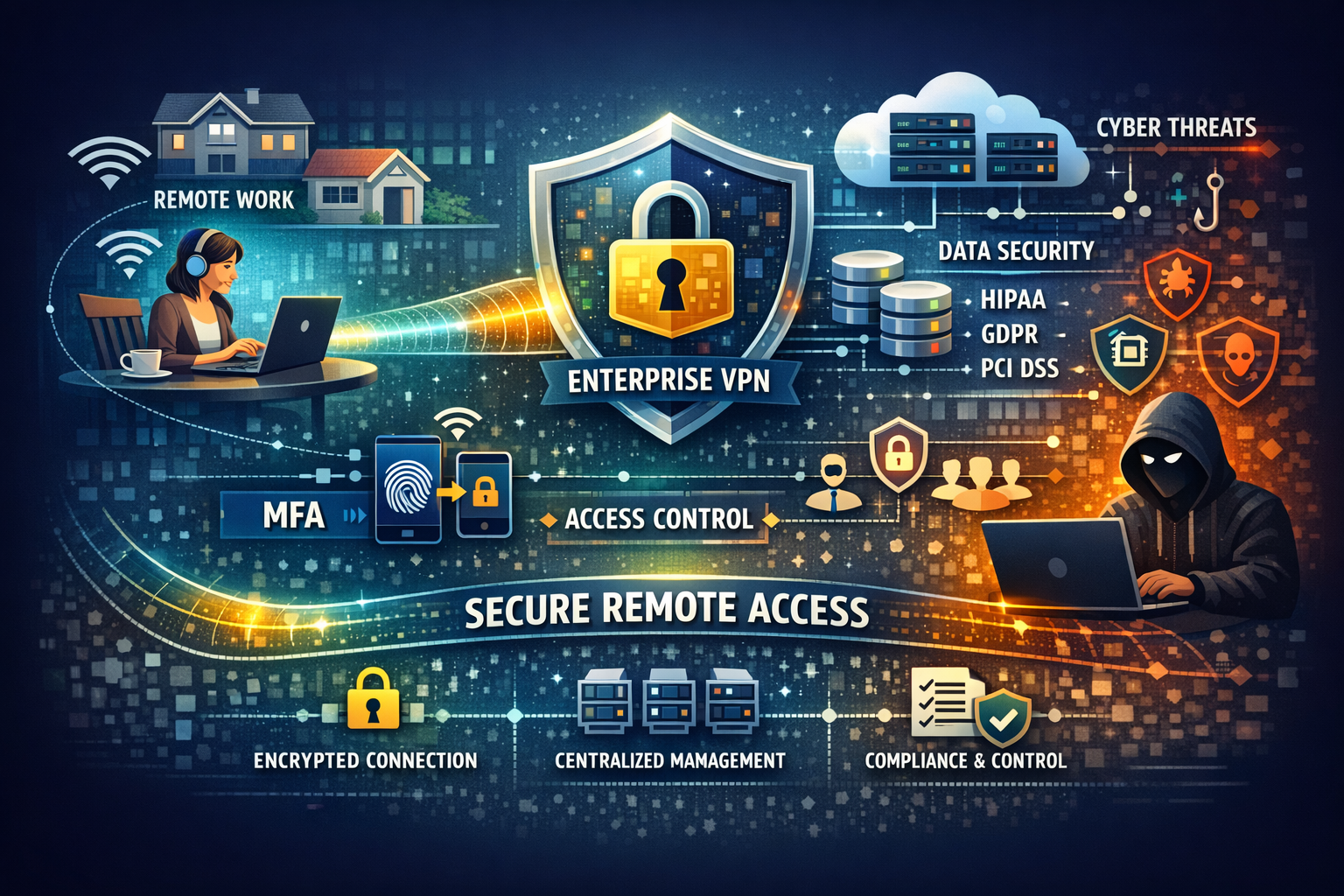
In today’s fast-moving business environment, secure access to corporate networks is no longer optional. With employees working remotely, traveling frequently, or accessing systems through public Wi-Fi, businesses face constant security risks. Protecting sensitive data, internal applications, and communication channels has become a top priority. This is where an enterprise VPN plays a critical role.
An enterprise VPN, or Virtual Private Network, creates a secure and encrypted connection between employees and company systems. Whether someone is working from home, a hotel, or a café, an enterprise VPN ensures that corporate data remains protected from cyber threats, unauthorized access, and data leaks.
In this article, we will explain what an enterprise VPN is, why it is essential for modern businesses, how it differs from consumer VPNs, and how to choose the right solution.
What Is an Enterprise VPN?
An enterprise VPN is a network security solution designed specifically for organizations to secure data traffic between remote users and internal business infrastructure. Unlike personal or consumer VPNs, which mainly focus on privacy and location masking, enterprise VPNs are built for security, control, scalability, and centralized management.
These VPNs create encrypted tunnels that protect data as it travels over the internet. Even if an employee connects through an unsecured public network, the encrypted connection ensures that sensitive information cannot be intercepted.
Enterprise VPNs are especially important for companies that handle confidential data, customer records, financial information, or intellectual property.
Core Functions of an Enterprise VPN
-
Encryption of all network traffic
-
Authentication of users and devices
-
Role-based access control
-
Centralized management for IT teams
-
Secure access to internal applications and cloud systems
Why Enterprise VPNs Matter for Business
Cybersecurity threats continue to grow in number and sophistication. Businesses of all sizes are targeted by hackers, phishing campaigns, and malware attacks. Without secure connectivity, data transmitted over open networks can easily be compromised.
Below are key reasons why an enterprise VPN is essential for businesses.
Secure Remote Work
Remote and hybrid work models are now standard across many industries. Employees access company systems from different locations and devices, increasing security risks.
An enterprise VPN secures communication between employee devices and the corporate network. It ensures that business data stays encrypted even when employees connect through home or public Wi-Fi networks.
Data Protection and Regulatory Compliance
Many industries must comply with strict data protection regulations such as HIPAA, GDPR, and PCI DSS. These regulations require businesses to protect sensitive data and control access to systems.
Enterprise VPNs help meet compliance requirements by encrypting data, enforcing access policies, and maintaining activity logs for auditing purposes.
Better Control Over Network Access
Enterprise VPNs allow IT teams to control who can access specific systems and data. Access can be granted based on job roles, device type, or location.
This reduces the risk of unauthorized access and limits potential damage if a user account is compromised.
Enterprise VPN vs Consumer VPN: Key Differences
Not all VPNs are designed for business use. Consumer VPNs and enterprise VPNs serve very different purposes.
| Feature | Consumer VPN | Enterprise VPN |
|---|---|---|
| Primary purpose | Personal privacy | Secure corporate access |
| User management | Individual users | Centralized IT control |
| Scalability | Limited | Supports large teams |
| Access control | Minimal | Advanced role-based |
| Business integration | No | Yes |
Consumer VPNs focus on hiding IP addresses and bypassing content restrictions. While useful for individuals, they lack the security controls, monitoring, and scalability required by businesses.
Enterprise VPN solutions integrate with business systems like identity management platforms and support advanced authentication methods such as multi-factor authentication.
Essential Features of an Enterprise VPN
When choosing an enterprise VPN solution, businesses should look for the following features.
Centralized Management
IT teams should be able to manage users, devices, access policies, and permissions from a single dashboard. Centralized control simplifies administration and improves security visibility.
Strong Encryption and Security Protocols
A reliable enterprise VPN should support secure protocols such as IPsec, SSL/TLS, and IKEv2. These protocols ensure data remains protected during transmission.
Scalability
As businesses grow, their VPN solution should scale without performance issues. A good enterprise VPN can support new users, locations, and devices easily.
Multi-Factor Authentication (MFA)
MFA adds an extra layer of security by requiring additional verification beyond passwords. This significantly reduces the risk of unauthorized access.
Performance and Reliability
Security should not slow down productivity. Enterprise VPNs should offer fast, stable connections to support cloud applications, video conferencing, and real-time collaboration tools.
Best Practices for Implementing an Enterprise VPN
Deploying an enterprise VPN requires more than just installation. Proper planning and management are essential.
Define Clear Access Policies
Not all users need access to every system. Use role-based access controls and follow the principle of least privilege to minimize security risks.
Enforce Strong Authentication
Use strong passwords and enable multi-factor authentication for all VPN users. This protects accounts even if credentials are leaked.
Monitor and Audit Activity
Regular monitoring and auditing help detect unusual behavior early. Logs should track login attempts, locations, and device usage.
Educate Employees
Employees should understand the importance of using the VPN and following security best practices, especially when working remotely.
Choosing the Right Enterprise VPN Provider
Selecting the right enterprise VPN provider involves balancing security, usability, and long-term support. Businesses need a solution that is easy to deploy, secure by design, and flexible enough to support modern work environments.
A reliable option for businesses is V3VPN’s enterprise VPN solution, designed to provide secure remote access with centralized control and strong encryption. It supports scalable deployment, advanced security features, and simplified management, making it suitable for growing organizations.
Businesses looking for a secure and scalable enterprise VPN solution for businesses can explore more details here:
👉V3VPN
Conclusion
As cyber threats increase and remote work continues to grow, implementing a secure enterprise VPN is no longer a choice but a necessity. An enterprise VPN protects sensitive data, ensures secure remote access, and helps businesses meet compliance requirements.
By selecting the right enterprise VPN, enforcing strong security policies, and educating employees, organizations can build a secure and reliable foundation for their digital operations.