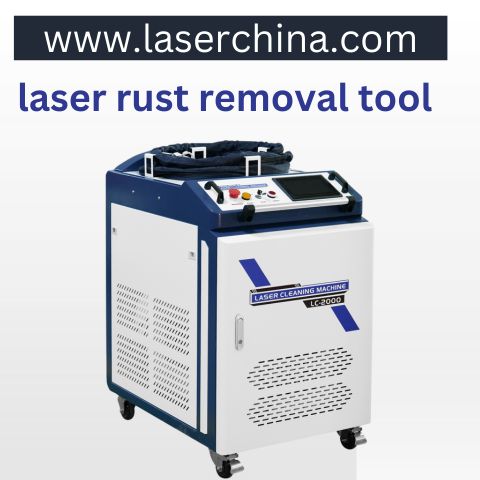
The laser rust removal tool has become an essential solution for modern surface preparation and metal restoration across multiple industries. Designed to address corrosion, oxidation, and surface contamination, this technology is widely adopted in manufacturing plants, fabrication workshops, shipyards, automotive facilities, and maintenance operations where clean metal surfaces are critical.
Rust forms when metal reacts with moisture and oxygen over time, leading to structural degradation and surface damage. Traditional rust removal methods such as sandblasting, chemical stripping, or manual grinding are still used, but many industries are shifting toward laser-based cleaning systems due to their precision and process control. The laser rust removal tool operates by directing controlled laser energy onto corroded surfaces, breaking the bond between rust layers and the base metal without mechanical contact.
How Laser Rust Removal Works in Practice
A laser rust removal tool uses concentrated light energy to interact with oxidized material on metal surfaces. When the laser beam passes over rusted areas, the oxidized layer absorbs the energy and detaches from the metal substrate. The base material reflects the laser energy differently, allowing the rust to be removed while preserving the original surface profile.
This process is typically performed in a controlled scanning pattern, ensuring uniform cleaning across flat or irregular surfaces. The laser parameters such as pulse duration, frequency, and power level are adjusted based on the metal type, rust thickness, and surface condition. This adaptability allows the laser rust removal tool to be used on steel, iron, aluminum alloys, and other industrial metals.
Industrial Applications of Laser Rust Removal Tool
The laser rust removal tool is widely applied across industries where metal integrity and surface quality are important. In manufacturing environments, it is used to clean metal parts before welding, coating, or assembly. Removing rust ensures better adhesion during painting or surface treatment processes.
In the automotive sector, restoration workshops use laser systems to clean chassis components, engine parts, and structural frames. Unlike abrasive methods, laser cleaning allows technicians to access tight corners, edges, and complex geometries without altering part dimensions.
Shipbuilding and marine maintenance operations rely on laser rust removal tools for hull maintenance, deck components, and structural reinforcements. Rust accumulation in marine environments is common, and laser cleaning enables targeted surface preparation without introducing secondary waste materials.
In infrastructure maintenance, laser cleaning is used on bridges, pipelines, rail components, and heavy machinery. The ability to remove corrosion without dismantling large structures makes this technology valuable for on-site maintenance tasks.
Role in Surface Preparation and Coating Processes
Surface preparation is a critical step before painting, galvanizing, or applying protective coatings. The laser rust removal tool prepares metal surfaces by eliminating rust, oxide layers, and residual contaminants. A properly cleaned surface ensures consistent coating thickness and long-term durability.
In fabrication workshops, laser cleaning is integrated into production lines to prepare metal sheets or components prior to forming or joining operations. By maintaining a controlled and repeatable cleaning process, manufacturers achieve uniform surface conditions across large production volumes.
Laser cleaning is also used to remove old coatings, paint residues, or surface films before reapplication. This makes the laser rust removal tool suitable for refurbishment projects where surface renewal is required without excessive material removal.
Use in Precision and Sensitive Environments
One of the reasons industries adopt the laser rust removal tool is its suitability for precision cleaning tasks. In aerospace and defense manufacturing, components often require cleaning methods that do not introduce surface stress or deformation. Laser-based rust removal supports strict quality requirements by maintaining surface accuracy.
Electronics and tooling industries also utilize laser cleaning to remove oxidation from molds, dies, and precision components. Maintaining tight tolerances is critical in these sectors, and laser cleaning allows controlled material interaction.
The laser rust removal tool is often used in indoor facilities where dust control and cleanliness are required. Since the process does not rely on abrasive media, it helps maintain cleaner work environments and supports compliance with industrial safety standards.
Equipment Configuration and Operation
Laser rust removal tools are available in various configurations, including handheld systems, portable units, and stationary industrial machines. Handheld models are commonly used for fieldwork, repairs, and maintenance tasks, while stationary systems are integrated into automated production lines.
Operators control the cleaning process using adjustable parameters based on surface condition and application requirements. Proper training ensures effective use of the equipment and consistent results. Industrial setups may include fume extraction systems to manage particles released during rust removal.
Maintenance of a laser rust removal tool typically involves routine inspection of optical components, cooling systems, and power units. Proper maintenance ensures stable performance and extends equipment lifespan.
Adoption Across Global Markets
Global demand for laser rust removal tools continues to grow as industries modernize surface treatment processes. Manufacturing hubs in Asia, Europe, and North America are investing in laser cleaning technology to improve production efficiency and quality control.
Export-oriented industries often adopt laser systems to meet international quality standards and surface cleanliness requirements. The ability to deliver repeatable and documented cleaning results supports compliance in regulated sectors such as aerospace, automotive, and heavy engineering.
Small and medium-sized enterprises are also adopting compact laser rust removal tools as they become more accessible. Portable systems allow workshops to perform advanced cleaning tasks without outsourcing, supporting faster turnaround times for repair and restoration projects.
Considerations When Selecting a Laser Rust Removal Tool
Selecting a laser rust removal tool involves evaluating application requirements, material types, and operational conditions. Power level selection depends on rust thickness and cleaning speed expectations. Lower power systems are suitable for light corrosion and precision work, while higher power units handle heavy industrial rust removal tasks.
Work environment considerations include space availability, power supply, and ventilation requirements. Portable units are preferred for on-site work, while fixed installations suit continuous production environments.
Training and technical support are also important factors, as proper operation ensures consistent cleaning quality. Many industrial users prioritize systems that integrate easily into existing workflows and maintenance routines.
Role in Modern Metal Restoration
Metal restoration projects benefit from the controlled approach provided by the laser rust removal tool. Historical restoration, machinery refurbishment, and industrial equipment overhaul often require rust removal without altering original material surfaces.
By enabling targeted cleaning, laser systems support restoration goals where material preservation is important. Workshops specializing in restoration increasingly rely on laser technology to handle delicate or high-value metal components.
The laser rust removal tool has also gained recognition in art restoration and cultural preservation, where metallic artifacts require careful cleaning. The ability to remove corrosion while maintaining original texture supports conservation standards.
Integration with Automated Systems
In advanced manufacturing facilities, laser rust removal tools are integrated with robotic arms and automated handling systems. Automation ensures consistent cleaning patterns and reduces manual intervention in high-volume production environments.
These integrated systems are commonly used in automotive body manufacturing, steel processing plants, and heavy equipment production lines. Automation allows continuous operation and supports quality assurance processes through repeatable cleaning cycles.
Data monitoring and process control systems may be paired with laser cleaning equipment to track operational parameters and cleaning consistency. This supports traceability and process optimization in large-scale industrial applications.
Industry Outlook and Practical Use
The laser rust removal tool continues to shape modern surface cleaning practices across industrial sectors. Its adoption reflects a broader shift toward controlled, precise, and efficient manufacturing and maintenance processes. As industries focus on improving surface quality and operational reliability, laser-based rust removal remains a practical solution for metal cleaning and preparation tasks.
With applications spanning manufacturing, maintenance, restoration, and automation, the laser rust removal tool has established itself as a reliable option for addressing corrosion challenges in diverse working environments.