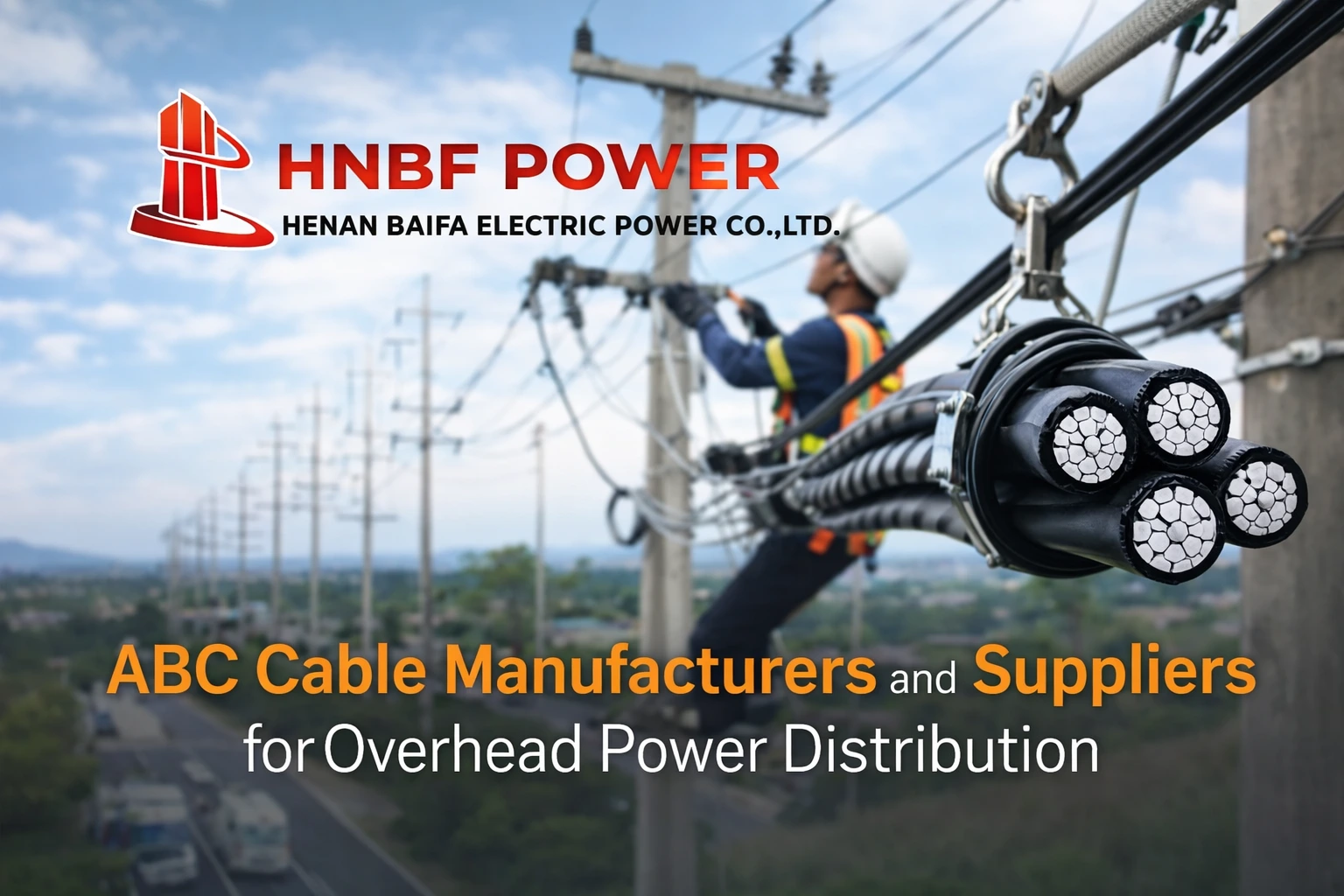
In today’s rapidly evolving power distribution landscape, utilities and EPC (Engineering, Procurement & Construction) partners are constantly seeking solutions that reduce installation costs, improve safety, and minimize outages. ABC cable (Aerial Bundle Cable) has emerged as a high‑performance alternative to traditional bare conductors in low‑voltage overhead distribution systems.
As a global manufacturer of overhead conductors and power cables, HNBF Power understands the technical and commercial pressures that utilities face. In this guide, we explore what ABC cable is, why it matters for grid modernization, and how to select the best option for optimized performance and total cost of ownership.
What Is ABC Cable?
Aerial Bundle Cable (ABC) is a bundled assembly of insulated conductors, typically 3‑phase plus neutral, designed for overhead distribution applications. Unlike bare conductors that require separate insulators and hardware, ABC cable integrates the insulation around each conductor and is supported with spacers and messenger wires for mechanical strength.
Key attributes include:
-
Insulated conductors that enhance safety and reduce flashovers.
-
Compact design that lowers right‑of‑way interference.
-
Reduced hardware and splice requirements that simplify installation.
Why ABC Cable Is Gaining Traction in Modern Power Distribution
Traditional bare conductors such as AAC (All‑Aluminum Conductor) and ACSR (Aluminum Conductor Steel Reinforced) have served utilities well for decades. However, urban expansion, safety regulations, and increasing reliability expectations have accelerated adoption of insulated solutions like ABC cable.
Enhanced Safety and Reduced Outages
A major pain point for utilities and municipalities is the risk of contact with vegetation, animals, or people, which can lead to faults and unplanned outages. ABC cable’s insulated conductors significantly reduce the likelihood of short circuits and tree‑related interruptions, particularly in densely populated or high‑vegetation zones.
Faster, Lower‑Cost Installation
Installing bare conductors requires a series of crossarms, insulators, and careful tensioning. With ABC cable, many of these components are consolidated. This streamlined system lowers labour hours, minimizes accessory costs, and accelerates commissioning timelines — a clear advantage for project planners and procurement teams operating under tight schedules.
Reduced Right‑of‑Way Constraints
In congested corridors or urban neighborhoods, clearance from buildings and infrastructure can limit design options. ABC cable’s compact bundle footprint enables tighter clearances without compromising compliance, enabling more flexible routing and less disruption during construction.
Improved Reliability in Extreme Conditions
In regions with frequent storms, icing, or heavy winds, bare conductor systems are susceptible to galloping and clashing, leading to mechanical fatigue. The bundled design of ABC cable dampens dynamic motion, helping improve long‑term reliability and decrease maintenance calls.
Technical Considerations When Specifying ABC Cable
Selecting the right ABC cable requires a clear understanding of system requirements, environmental conditions, and long‑term performance expectations.
Conductor Material and Size
ABC cables are typically made from high‑conductivity aluminum alloys that balance electrical performance with mechanical strength. Depending on load requirements, phase conductors can vary in cross‑section, offering tailored ampacity and minimal voltage drop.
Insulation Material
Polymeric insulation (such as XLPE) is standard, providing excellent dielectric properties, weather resistance, and durability. Evaluate the thermal rating and UV resistance of the insulation to ensure suitability for your operating environment.
Mechanical Support Components
ABC systems rely on spacers, messenger wires, and suspension clamps to maintain geometry and mechanical integrity. Proper selection of these accessories ensures tension control, reduced sag, and compliance with design loads.
Jointing and Termination
While ABC cable reduces hardware count, joints and terminations remain critical. Reliable connectors and sealing systems help maintain insulation integrity and prevent moisture ingress, which is essential for long service life.
ABC Cable vs Bare Conductors: A Practical Comparison
| Feature | ABC Cable | Bare Conductors (AAC/ACSR) |
|---|---|---|
| Safety | High (insulated conductors) | Lower (exposed conductors) |
| Hardware Requirements | Minimal | High (insulators, crossarms) |
| Installation Speed | Faster | Slower |
| Vegetation Interference | Reduced | High |
| Reliability in Urban Areas | Improved | Standard |
| Maintenance Needs | Lower | Higher |
This comparison highlights why many utilities are shifting to ABC cable for new builds and retrofit projects.
Case Scenarios: When ABC Cable Is Ideal
Urban and Suburban Distribution
In high‑density areas with limited clearances and many obstacles, ABC cable provides a compact, safer alternative that reduces risk exposure and enhances system resilience.
Regions with Vegetation Challenges
Where tree growth and wildlife interference are common, ABC cable’s insulation helps mitigate faults and reduce outage frequency, lowering total operating costs.
Retrofit Projects
Replacing aging bare conductor networks with ABC cable can transform reliability metrics while reducing the complexity of future maintenance.
How HNBF Power Supports Your ABC Cable Requirements
At HNBF Power, we offer a comprehensive range of aerial bundle cable solutions designed to meet stringent performance and safety standards. Our global manufacturing footprint, quality control systems, and engineering support ensure that your ABC cable specifications align with energy demands and regulatory requirements.
Whether you’re planning a new distribution network or upgrading existing infrastructure, our team can:
-
Assist with load analysis and ampacity selection
-
Provide technical support on jointing and termination solutions
-
Offer customized cable designs tailored to environmental conditions
-
Ensure timely delivery and compliance documentation
FAQs About ABC Cable
1. What voltage levels are typical for ABC cable applications?
ABC cable is most commonly used in low‑voltage distribution networks (up to 1 kV). Its design is optimized for neighborhood and feeder circuits where safety and reliability are critical.
2. Can ABC cable be used in high‑wind or coastal environments?
Yes. ABC cable designs with appropriate mechanical support and corrosion‑resistant materials are suitable for high‑wind and coastal applications when specified correctly.
3. Does ABC cable reduce maintenance costs?
Yes. Insulated conductors minimize vegetation‑related faults and reduce the frequency of physical inspections and emergency repairs.
4. How does ABC cable improve safety?
Insulation on each conductor reduces the risk of accidental contact and flashovers, enhancing public and worker safety.
5. Are there special installation tools required for ABC cable?
Installation requires standard overhead distribution tools, plus accessories for spacers and terminations. Manufacturers like HNBF Power provide detailed installation guides.
Conclusion: Choose ABC Cable for Reliable, Cost‑Effective Distribution
As grid demands evolve, so should your approach to distribution infrastructure. ABC cable delivers a compelling combination of safety, performance, and cost savings for utilities and EPC professionals.
For expert guidance on selecting the right ABC cable design for your project, contact HNBF Power today. Our engineering team is ready to support your customized solutions and help you achieve reliable distribution outcomes.
Contact HNBF Power for tailored ABC cable solutions and technical support.