For years, SEO success revolved around one dominant factor: links. The more high-quality backlinks a website earned, the higher it ranked at least in theory. But search engines have evolved dramatically, and so has the way they evaluate relevance, trust, and expertise.
Today, topical authority has emerged as a powerful ranking driver, challenging the long-held dominance of traditional link building. With AI-powered search, semantic understanding, and entity-based indexing becoming the norm, the question many marketers are asking is:
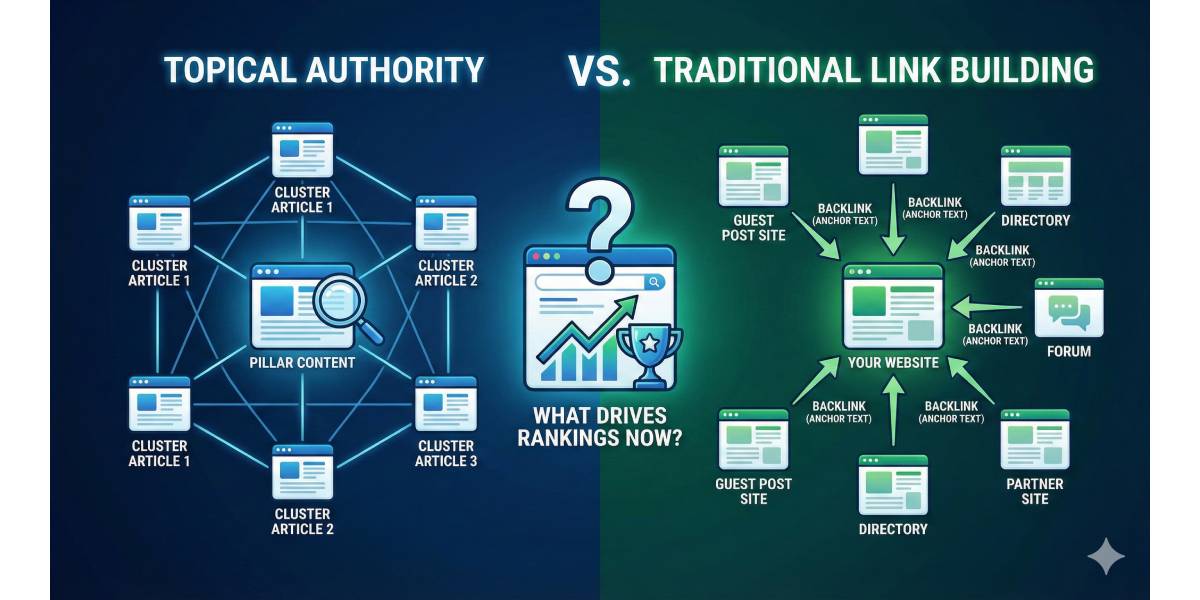
What really drives rankings now topical authority or backlinks?
The answer isn’t as simple as choosing one over the other. Let’s break down how modern search engines evaluate both, how their roles have changed, and how you can build an SEO strategy that works in today’s search landscape.
Understanding Traditional Link Building
Traditional link building focuses on acquiring backlinks from other websites to improve domain authority and ranking potential. For a long time, links were treated as “votes of confidence,” signaling that a website was trustworthy and valuable.
Why Link Building Worked So Well
- Links helped search engines discover new pages
- Anchor text provided keyword relevance
- High-authority backlinks transferred trust
- Competitive industries relied heavily on link volume
In many ways, backlinks were the backbone of SEO—and they still matter.
The Limitations of Traditional Link Building Today
While links remain an important ranking factor, relying on them alone is no longer enough.
1. Diminishing Returns
A few strong, relevant links can help but mass link acquisition no longer guarantees results. Search engines have become extremely good at identifying:
- Paid links
- Link schemes
- Irrelevant guest posts
- Private blog networks (PBNs)
2. Context Matters More Than Count
A single contextual link from a relevant, authoritative page often outweighs dozens of generic backlinks.
3. Links Don’t Always Prove Expertise
Links can show popularity, but they don’t always demonstrate depth of knowledge. That’s where topical authority comes in.
What Is Topical Authority?
Topical authority refers to how deeply and comprehensively a website covers a specific subject area. Instead of ranking pages in isolation, search engines now evaluate how well your entire site demonstrates expertise around a topic.
In simple terms:
If your website consistently answers all important questions about a topic, search engines are more likely to trust and rank it.
Why Search Engines Favor Topical Authority
Modern search engines use AI and natural language processing to understand meaning, context, and relationships between topics.
Topical authority helps search engines:
- Identify subject-matter experts
- Reduce reliance on exact-match keywords
- Deliver more accurate, helpful results
- Power AI-generated answers and overviews
This shift is especially important in competitive niches where surface-level content is everywhere.
How Topical Authority Is Built
Topical authority isn’t achieved through a single article—it’s built systematically.
1. Topic Clusters and Content Depth
Instead of writing one article per keyword, authoritative websites create:
- Pillar pages covering broad topics
- Supporting articles targeting subtopics
- Logical internal linking between related content
This structure shows search engines that your site understands the topic holistically, not partially.
2. Semantic Coverage Over Keyword Stuffing
Modern SEO focuses on:
- Related terms
- Concepts
- Entities
- User intent
You don’t need to repeat the same keyword endlessly. You need to answer the topic fully.
3. Consistency and Focus
Websites that jump between unrelated niches struggle to build authority. Search engines reward:
- Clear topical focus
- Industry relevance
- Content consistency over time
For example, a business offering seo services in Pakistan gains stronger authority by publishing in-depth content around SEO, digital marketing, analytics, and search trends—rather than random, unrelated topics.
Topical Authority vs Link Building: A Direct Comparison
| Factor | Traditional Link Building | Topical Authority |
| Focus | External signals | Internal expertise |
| Speed of impact | Faster (short-term) | Slower but long-lasting |
| Risk level | Higher (penalties possible) | Low risk |
| Sustainability | Can decay over time | Compounds over time |
| AI-first search | Less dominant | Highly influential |
Both matter, but their roles have changed.
What Actually Drives Rankings Now?
1. Topical Authority Sets the Foundation
Without topical authority:
- Pages struggle to rank consistently
- New content takes longer to index and rank
- Links have reduced impact
Search engines increasingly ask:
“Is this website an expert on this topic?”
If the answer is no, even strong backlinks may not help much.
2. Links Still Act as Trust Accelerators
Backlinks haven’t disappeared, they’ve evolved.
Today, links:
- Validate authority rather than create it
- Work best when pointing to strong, in-depth content
- Amplify topical authority instead of replacing it
Think of topical authority as the engine, and links as the fuel.
How AI and Semantic Search Changed the Game
AI-driven search systems analyze:
- Content relationships
- Topic completeness
- Entity associations
- Historical performance
This means:
- One strong page is no longer enough
- Thin content with strong links is less effective
- Comprehensive coverage beats isolated optimization
AI prefers trusted sources, not just well-linked pages.
The Role of Internal Linking in Topical Authority
Internal linking is often overlooked, but it’s critical.
Strong internal links:
- Distribute authority across related pages
- Help search engines understand topic structure
- Improve crawl efficiency
- Strengthen pillar–cluster relationships
A well-planned internal linking strategy can sometimes outperform external links; especially in content-heavy websites.
Rethinking Link Building for Modern SEO
Modern link building should support topical authority, not exist separately.
Effective Link Strategies Today:
- Editorial guest posts on niche-relevant websites
- Digital PR and brand mentions
- Contextual links within authoritative content
- Thought leadership and original research
Low-quality, mass link tactics are not just ineffective—they’re risky.
The Ideal SEO Strategy: Authority First, Links Second
Instead of asking “How many links do I need?”, modern SEO asks:
“How well does my site answer this topic compared to competitors?”
A winning approach looks like this:
- Define a clear topical niche
- Build comprehensive, structured content
- Strengthen internal linking
- Earn high-quality, relevant backlinks
- Continuously update and expand content
This strategy works across industries and search updates.
Measuring Success Beyond Rankings
To evaluate topical authority, look beyond keyword positions.
Key indicators include:
- Faster indexing of new content
- Increased impressions across related queries
- Higher rankings for long-tail keywords
- Growth in branded searches
- Inclusion in AI-generated answers
These are signs your site is being recognized as an authority.
Final Thoughts: It’s Not Either–Or
The debate between topical authority and traditional link building misses the point.
Topical authority drives rankings.
Links reinforce trust.
In today’s SEO landscape, the most successful websites are those that combine deep subject expertise with strategic, high-quality backlinks. Businesses that prioritize authority-first SEO—supported by ethical link building and expert-led seo services in Pakistan are far better positioned to win in both current rankings and the future of AI-driven search.
SEO hasn’t become harder, it’s become smarter. And those who adapt will lead.