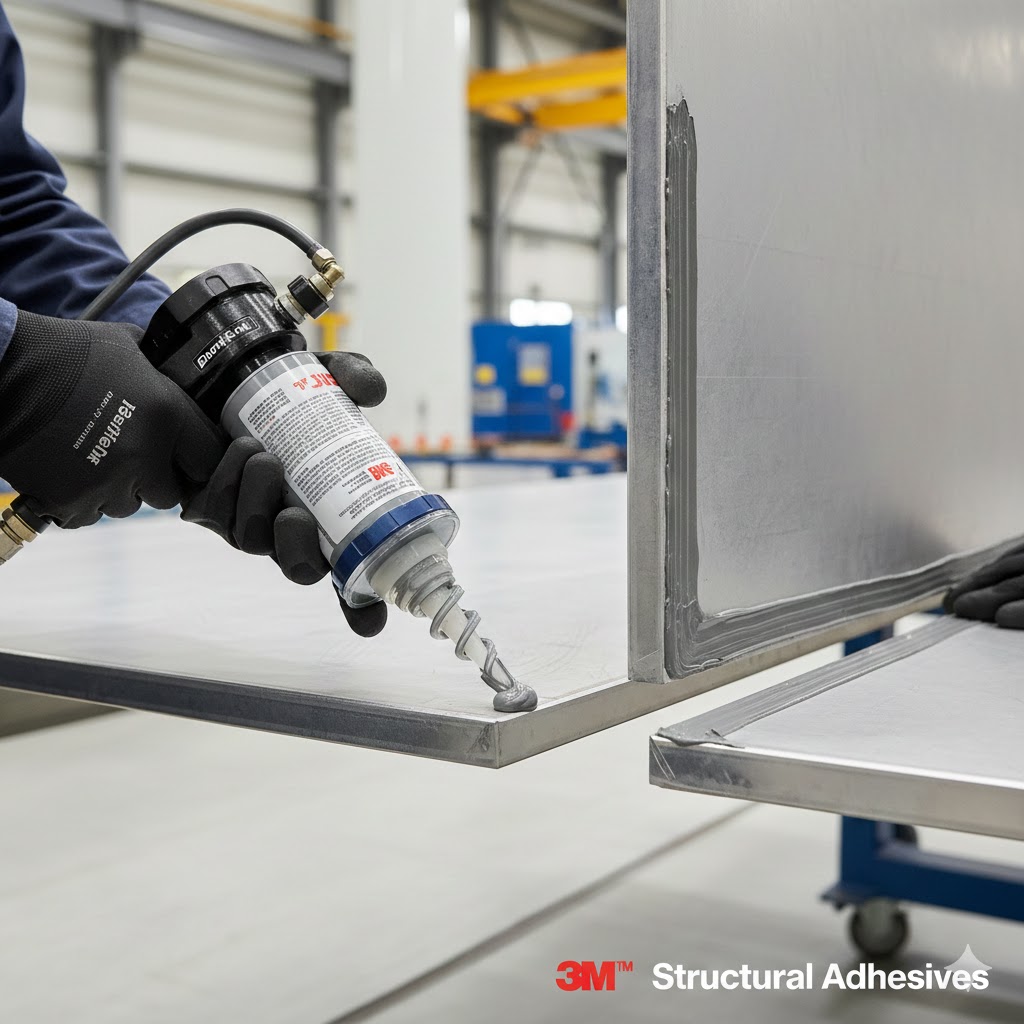
When you think of “heavy-duty” assembly, your mind probably goes straight to welding, bolts, and rivets. While these traditional methods have worked for decades, they come with baggage: high heat, heavy weight, and the risk of rust.
Enter 3M adhesives.
In the modern world of manufacturing and construction, structural adhesives have changed the game. They aren’t just “glue”; they are high-tech chemical bonds designed to hold planes together, keep skyscrapers safe, and make cars lighter and stronger.
In this guide, we will explore why 3M structural adhesives are the top choice for heavy-duty projects and how to choose the right one for your needs.
What Are 3M Structural Adhesives?
A “structural” adhesive is defined by its strength. To earn this title, an adhesive must be able to support a significant load—usually at least $1,000 of overlap shear strength. Unlike your household craft glue, these are engineered to become a permanent part of the structure.
3M offers three main “families” of structural adhesives:
-
Epoxies: Known for the highest strength and heat resistance.
-
Acrylics: Great for bonding different materials (like plastic to metal) and oily surfaces.
-
Urethanes: Highly flexible and perfect for things that vibrate or move.
Why Choose 3M Adhesives Over Welding or Bolts?
If you are working on a heavy-duty project, you might wonder: Why trust a chemical bond over a steel bolt? Here is the breakdown of why professionals are making the switch.
1. Better Stress Distribution
When you use a bolt or a rivet, all the pressure is concentrated on one tiny hole. This creates “stress points” where cracks often start. 3M adhesives spread the load across the entire surface area of the bond. This makes the overall structure much stronger and less likely to fail under pressure.
2. Aesthetics and Weight Saving
Welding leaves burn marks and bumps that need grinding and painting. Bolts add weight and stick out. Adhesives are hidden inside the joint, leaving the outside surface perfectly smooth. Plus, for industries like aerospace or automotive, removing heavy metal fasteners significantly reduces weight and improves fuel efficiency.
3. Bonding Dissimilar Materials
You can’t weld aluminum to plastic. You can’t bolt glass to steel without a high risk of breaking it. 3M adhesives act as a bridge, allowing you to bond completely different materials together while preventing “galvanic corrosion” (the rust that happens when two different metals touch).
The Big Three: Choosing Your 3M Powerhouse:
To get the best results, you need to match the adhesive to the job. Here are the most common 3M structural solutions for heavy-duty work.
3M Scotch-Weld Epoxy Adhesives
If your project needs to withstand extreme conditions, epoxy is your best friend.
-
Best for: Metal-to-metal bonding, heavy machinery, and high-heat environments.
-
Key Benefit: They offer the highest “creep resistance” (the ability to hold a load over a long time without stretching).
-
Popular Choice: 3M Scotch-Weld DP420—it is incredibly tough and stays strong even under impact.
3M Scotch-Weld Acrylic Adhesives
Working with plastics or surfaces that aren’t perfectly clean? Acrylics are the “easy-to-use” pros.
-
Best for: Bonding plastics, composites, and even slightly oily metals.
-
Key Benefit: They cure very fast and require less surface preparation than epoxies.
-
Popular Choice: 3M Scotch-Weld DP8407NS—specifically designed to stick to metal even through a powder-coating heat cycle.
3M Scotch-Weld Urethane Adhesives
If your project is going to be bumped, shaken, or moved around, you need something that won’t crack.
-
Best for: Signage, transportation vehicles, and dissimilar materials.
-
Key Benefit: They remain flexible. While an epoxy might be “brittle” under a hammer blow, a urethane will absorb the energy.
-
Popular Choice: 3M Scotch-Weld DP609—great for bonding wood, plastic, and metal where flexibility is key.
How to Apply 3M Adhesives for a Pro Finish:
Even the strongest adhesive will fail if it isn’t applied correctly. Follow these three simple steps for a bond that lasts a lifetime.
Step 1: Surface Preparation:
You wouldn’t paint a dirty wall; don’t glue a dirty surface.
-
Clean: Use isopropyl alcohol to remove grease and dust.
-
Abrade: Lightly scuff the surface with a 3M Scotch-Brite pad. This gives the glue more “teeth” to grab onto.
-
Dry: Ensure the surface is 100% dry before applying the adhesive.
Step 2: Proper Mixing:
Most heavy-duty 3M adhesives come in “Duo-Pak” cartridges. These use a mixing nozzle that ensures the two parts (base and accelerator) are perfectly blended. Never try to mix these by hand with a stick—you’ll end up with “soft spots” in your glue.
Step 3: Clamping and Curing:
Structural adhesives don’t dry instantly. They need time to “cross-link” chemically.
-
Fixation Time: This is the time during which you must keep the parts clamped and still.
-
Full Cure: Most 3M adhesives reach full strength in 24 to 48 hours. Don’t put a heavy load on your project until it’s fully cured!
Common Heavy-Duty Applications:
Where exactly are these 3M adhesives being used? You’d be surprised:
-
Transportation: Bonding side panels on buses and trailers to prevent rattling.
-
Renewable Energy: Constructing wind turbine blades and solar panel frames.
-
HVAC: Sealing industrial air units to prevent leaks without using 100 screws.
-
Signage: Mounting large outdoor signs that need to withstand high winds and rain.
Frequently Asked Questions (FAQ):
Q: How long do 3M structural adhesives last?
A: When applied correctly, these bonds are designed to last the life of the product—often 20+ years. They are resistant to moisture, chemicals, and UV light.
Q: Are 3M adhesives better than VHB Tape?
A: It depends. 3M VHB Tape is amazing for instant bonding and thin materials. However, for “heavy-duty” load-bearing structures where the parts might be under constant tension, a liquid structural adhesive is usually stronger.
Q: Do I need special tools?
A: For the professional 3M Scotch-Weld line, you will need an applicator gun (manual or pneumatic) and the correct mixing nozzles.
Final Thoughts: The Future of Assembly:
Switching to 3M adhesives for your heavy-duty projects isn’t just about sticking things together; it’s about building smarter. You get a stronger, lighter, and better-looking result while saving time on the assembly line.
Whether you are building a custom vehicle, repairing industrial equipment, or designing a new product, 3M has a chemical solution that can replace traditional fasteners.
Ready to find the perfect bond? Explore our full range of 3M structural adhesives and take your project to the next level today!